


How Power Outages Impact Small Restaurant Businesses: Lessons from Boulder and Ruzo Coffee


Power outages impose immediate, measurable costs on small restaurants. Boulder’s recent four-day outage—implemented by Xcel Energy as a fire-prevention measure during hurricane-force winds—underscored the economic exposure facing independent operators. In a market where margins are thin and working capital is tied up in perishable inventory, hours without power can translate into weeks of lost profit.
This decision-making framework emerged in the wake of the Marshall Fire, which destroyed more than 1,000 homes and caused billions in damage along the Front Range. Post‑Marshall, utilities have prioritized proactive shutoffs during extreme wind events to reduce ignition risk. For small businesses, that public-safety policy carries significant operational and financial implications.
The Operational and Economic Shock of an Outage
When power fails, core restaurant systems go offline simultaneously: espresso machines, refrigeration, point-of-sale, and payment processing. Sales halt, but fixed costs—rent, insurance, debt service—continue. Industry sources estimate that unplanned outages can quickly exceed $10,000 in combined lost revenue, spoilage, and recovery expenses for small and mid-sized businesses (Constellation Energy; Restaurant Business).
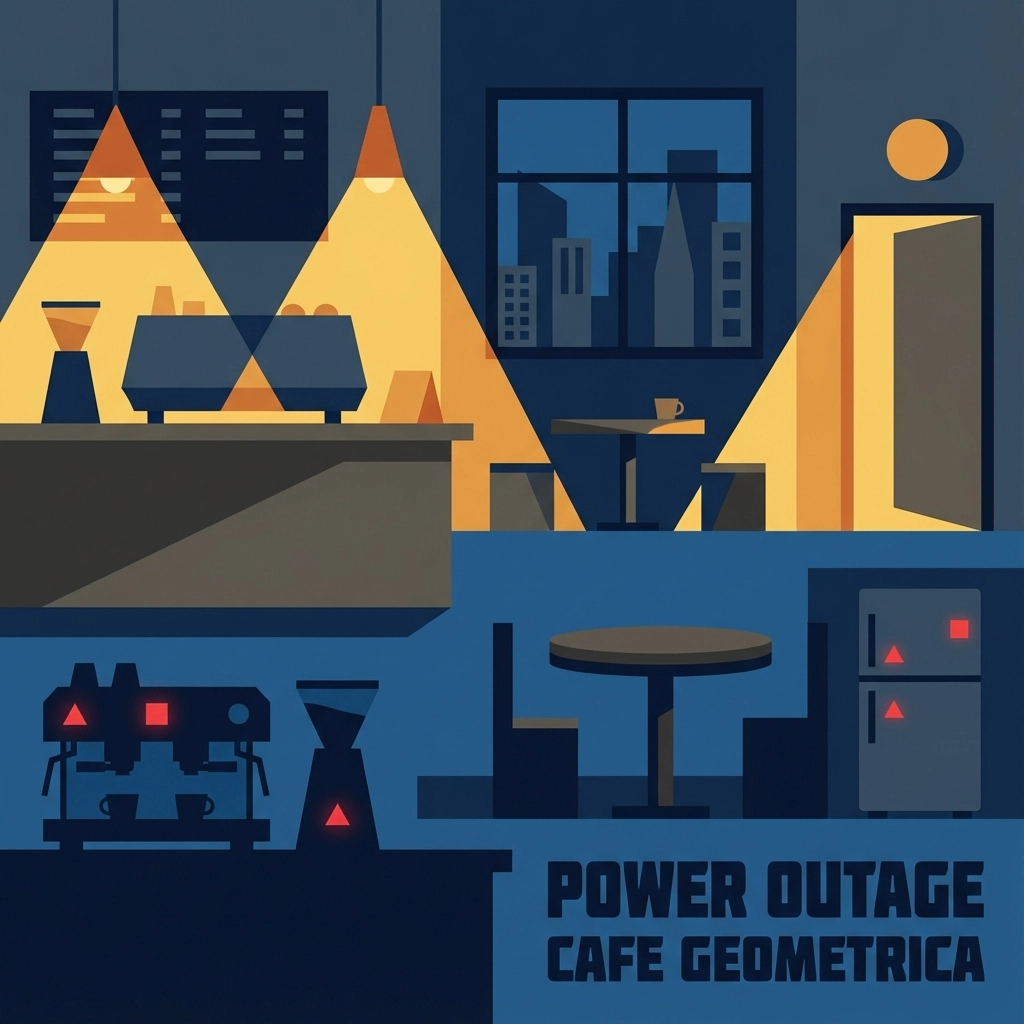
Real-world examples illustrate the magnitude. During a major San Francisco outage, Nopa Restaurant reported roughly $30,000 in lost weekend revenue, and its bakery lost about $3,000 (San Francisco Chronicle). Upstream partners also absorb losses as canceled orders ripple through suppliers and producers (San Francisco Chronicle).
Refrigerated Inventory: Disproportionate Financial Risk
Refrigeration represents a concentrated financial risk because it holds much of a restaurant’s working capital—milk and cream, pastries, sandwich ingredients, and prepared items. Without stable temperatures, losses mount quickly. At Butter Love Bakeshop, power interruptions forced staff to give away croissants after refrigeration failed (San Francisco Chronicle). In other bakeries, dough over‑fermented and had to be discarded.
Food-safety rules are clear: perishable foods kept above 40°F for more than two hours should be discarded (USDA FSIS). For coffee shops, that window can mean hundreds to thousands of dollars in product loss within a single morning.
Daily Consistency Is an Economic Imperative
For neighborhood restaurants and cafés, reliable daily operations are not just a service promise—they are an economic strategy. Routine visits anchor demand forecasting, labor scheduling, and supplier orders. Unexpected closures interrupt customer habits that take time and marketing dollars to rebuild, increasing the risk of long‑term revenue attrition even after power is restored.
Ruzo Coffee’s Role During Boulder’s Four‑Day Outage
During the outage, Ruzo Coffee maintained partial power. We were able to keep espresso service, refrigeration, heat, and Wi‑Fi online, allowing us to operate when most of our area was dark. We chose to serve as a practical community resource: a place to warm up, charge devices, access internet, and maintain a sense of normalcy. With that said with the power outage, we experienced our third and fourth busiest days on record, When people don't have heat or means of cooking the foot traffic triples.
Foot traffic reflected community needs as much as demand for coffee. Families without cooking options, remote workers lacking connectivity, and neighbors seeking a safe, warm space all used the shop. The experience reaffirmed a core principle: small businesses function as local infrastructure during disruptions, not just as retail operations.
From the Marshall Fire to Proactive Shutoffs
The Marshall Fire of December 2021 reshaped risk management along the Front Range. With extreme winds and heightened concern about energized lines under red‑flag conditions, utilities now employ proactive shutoffs to reduce the probability of wildfire ignition. This approach is appropriate from a safety standpoint, but it introduces predictable economic shocks for small businesses during wind events. Planning for deliberate outages—rather than only unexpected failures—is now part of operating reality in fire‑prone regions.

Building Practical Resilience
Preparation cannot eliminate outages, but it can blunt their financial impact. Practical steps include:
Assessing backup power options sized for refrigeration and essential service equipment
Reviewing insurance for spoilage, business interruption, and equipment coverage
Establishing clear customer communication plans across web, email, and social channels
Coordinating with suppliers on contingency orders and delivery timing
Above all, resilience should preserve what makes small businesses valuable to their neighborhoods: consistency, hospitality, and community connection.
Looking Ahead
High winds will return, and safety‑first shutoffs will likely continue. The economic task for small restaurants is to reduce spoilage risk, protect core revenue streams, and maintain daily consistency whenever possible. Our experience in Boulder showed that preparedness and community orientation can turn a disruptive event into an opportunity to serve.
If you found this useful, please share it with a friend who might benefit from the insights.
Works Cited
Constellation Energy. "Power Outage Safety Tips for Business Owners." Constellation, 2024, www.constellation.com/business/learn/power-outages.
"Power Outages Cost Small Business Owners Big Bucks." Restaurant Business, 2023, www.restaurantbusiness.com/technology/power-outages-cost-small-business-owners-big-bucks.
Roderick, Kevin. "SF Power Outage Brings Restaurants to Their Knees." San Francisco Chronicle, 15 Jan. 2024, www.sfchronicle.com/food/restaurants/article/sf-power-outage-restaurants-18649234.php.
United States Department of Agriculture. "Food Safety During Power Outages." USDA Food Safety and Inspection Service, 2024, www.fsis.usda.gov/food-safety/safe-food-handling-and-preparation/food-safety-basics/power-outages.
Comments